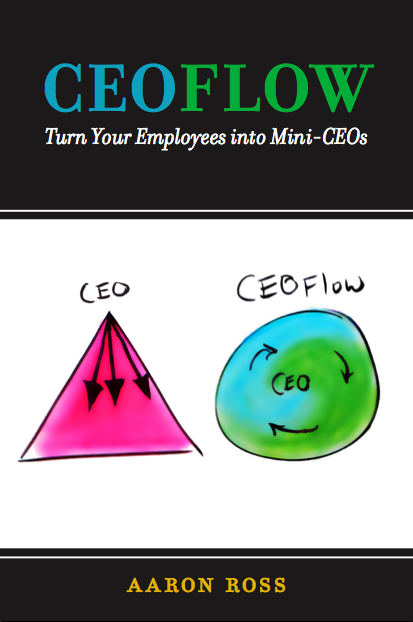
A Visual Intention For CEOFlow

Do I even need to write anything to describe my intention here, in how CEOs and their people should feel about how the culture and company work?   (Seriously – comment below if I do need to explain further!)

CEOFlow Triangle to Circle sketch

Where Outrageous Growth Comes From

It’s not from having a great product. Or perfect sales and marketing.  Those, for sustained success, are necessary…but what really creates lasting, outrageous growth is customer trust, success and love: that is, customers who love your service and can’t wait to tell others about it!  This is the basis for the massive success of companies like Google, Zappos, Facebook and Salesforce.com.

img_1264b

CEO Sweet Spot

This should be self-evident :)

ceoflow-sweet-spot

CEO as the Pebble In The Pond

Everything begins with the CEO.  Are they centered, or stressed?  The thoughts, feelings and actions of the CEO (whether trusting or fearful) will ripple out through their employees and to the market…and will come back around either as increased or reduced growth:

IMG_1265b

Problem Multiplication

In command-and-control organizations that have trained employees to require approval from all managers, issues and problems multiply because so many people must touch them.  The companies train people to not make decisions by requiring upper approval for everything.

In a self-managing organization, in which employees are encouraged to make (and live with) their own decisions, the problems are dealt with at the source before they ripple up the organization.

IMG_1268

What the text says:

  • Command & Control: Every problem escated / Decsisions pushed up
  • CEOFlow: Problems solved at source / Decisions pushed down

===============

Are we working harder, under more pressure, but running in place?

The internet has changed business – in helpful and challenging ways:
* We have more information and metrics – and more confusion from all the clutter.
* We can develop and deploy products faster – far beyond our clients’ ability to absorb them.
* We can find prospects more easily – but they’re less interested in talking with us.
* We have more forecasting tools – but less predictability.
* We work harder – but not as hard as the scrappy firms in India and China.

I’ve worked with, mentored and observed dozens of companies over the past couple of years. It’s not uncommon for the double whammy of clutter and pressure to make companies and people so busy that they can’t get anything done!

The brute force methods that used to work so well, such as “work harder,” “hire more,” “spend more” aren’t true strategic or competitive advantages. Anyone can work hard, hire people and raise more money.

It’s time to start taking regular breaths to reflect on what we’re missing – there is a better way to increase growth more productively. From my point of view, the most impactful thing a CEO can do to increase sustainable growth than to move towards a pull management system and away from a push management system.

How can a CEO create an environment that helps the company to grow itself faster by unlocking the motivation of its people in an environment of trust, transparency and alignment? Can a CEO spend 95%+ of their time enjoyably surfing the flow of growing a company, rather than feeling sometimes like they’re paddling against the waves?


Push v Pull Management

Note that companies are not pull OR push…there would be a sliding scale (such as 70/30 push/pull)

Push System
* The CEO actively works to motivate (push) people.
* Work is usually exhausting.
* The company does not trust employees, who must be monitored and pushed to do more.
* The company culture is pressured, competitive, political.
* The executive team and board come up with the vision and goals and push these out to the company.
* Goal setting and tracking metrics take up 80% of the attention; prioritization of projects and goals is 20%.
* The executive team then pushes the employees to hit those goals on a quarterly or monthly drumbeat.
* Mistakes are punished.
* Burnout is common.
* Does not require much time from management. High rates of internal confusion or mis-alignment are acceptable.

Pull System
* The CEO actively works to create an environment that unlocks people’s inherent motivation (their own motivation “pulls” them to sustainably achieve).
* Work is usually energizing.
* The company culture is enjoyable, nurturing, collaborative.
* The company trusts employees to pull what they need from management (advice, information, help) as necessary.
* All employees have an opportunity to include their voice/feedback in company goals and priorities.
*  The executive team and managers work to maintain constant clarity alignment across the company, even on a weekly drumbeat.
* Every employee has transparent access to (or feeds to) updates on the company’s priorities and goals, so they remain in a constant state of alignment.
* EVERY mistake is a learning opportunity to improve something.
* No burnout – employees, through conversations with their peers, have total discretion in how and when they can take time off.
* Requires more investment of time by management, but much more productive (like the Toyota Production System).

Next step? Continuing the CEO discussion

Shoot me an email if this is something that resonates and you want to participate now or in the future in this conversation: aaron(at)pebblestorm(dot)com.

Alexander Kjerulf is a great writer, and I recommend you check out his blog.  I’ve included a sample here of his last post (”The seeeeeeriously cool way out of a downturn”) that’s very relevant to what CEOs are dealing with today.

By the way, I would never tell a CEO to do everything they can to avoid layoffs.  Layoffs can hurt a culture, or it can help it – it depends on how they’re handled, and the unique situation of the company.  In fact, I’m often suggesting CEOs consider layoffs before they’re ready to accept the necessity themselves, because lots of companies, especially startups, tend to overhire and have too many people anyway.  Boards and CEOs like to make aggressive hiring plans based on aggressive growth…which often doesn’t come as fast as they want.

Having said that, if a company has a tight culture and feels that surviving a downturn without layoffs is the right course, this is a great example of a company that did it.
—————–
“The seeeeeeriously cool way out of a downturn”

Is there a better way out of a corporate crisis than layoffs? I’ve long felt that there has to be, and back in 2001 when my own IT company was deep in the hole, we fought hard to avoid laying off anyone (and succeeded).

I’m currently writing my second book which will be about keeping an organization happy during a crisis and one of the case stories I’ll be using is so good, that I just had to share it here.

The story is quite long, but it shows very clearly that there are better ways to handle a financial crisis than layoffs and panic. Enjoy!

wim

The economy may be bad, but Wim Roelandts isn’t really bothered much by that because, as he told me, this is his 8th. recession so far.

Wim’s worst crisis as a leader came in 2000 when Xilinx, a computer chip manufacturer based in  Silicon Valley, got hit hard and fast by the dot-com crisis. In the December 2000 quarter their revenue was $450 million – 9 months later, their revenues for the September 2001 quarter was down to only $225 million.

Something had to be done, and fast, but what? Wim Roelandts, an affable Belgian who is usually seen with a smile on his face, was the CEO back then and was clearly facing some tough decisions. And while Xilinx’ closest competitors wasted little time in firing a large percentage of their staff to cut costs, Wim felt here had to be a better way.

He came up with a plan for his organization and the 2.800 people in it and called it “Share the pain”.

The plan had three simple components…continue to the full article

Sharing something here for any CEOs/board members into fast cars, Richard Branson, or are just feeling stressed and need a break… (by the way, the “Me” on here is Yanik Silver, not moi):

In Silicon Valley/Los Angeles it’s pretty grim here for many CEOs/owners – especially the ones of venture-funded companies. I see that the more stressed they get, the less able they are to get a clear picture of what they need to do to succeed. Whether it’s racing fast cars or going for a hike, getting some mental space, regularly, makes a big difference in your productivity (a big reason why I have CEO groups going in SF and LA – getting together with peers can also create that space).

A friend of mine, Yanik Silver (who’s offer to share PebbleStorm with his audience catalyzed me to launch PebbleStorm this week), has a cool business (Maverick Business Adventures) of putting together mini-adventures for CEOs, combining fun and networking/business sessions, and he has a few spots open for two upcoming events:

Brainstorm with Richard Branson on his private island, Necker (all proceeds go to charity):
www.maverickbusinessadventures.com/necker/

200+mph racing trip in Miami Fl:
www.MaverickBusinessAdventures.com/200mph

If you sign up, send me pictures!

Aaron Ross

hot-coalsEric Golden (CEO of Equipois) & I (Aaron Ross bio) are organizing a formal, facilitated CEO group here on the westside that will meet monthly. The theme of CEOFlow is to explore what it takes to create predictable revenue & sustainable growth.  It will consist of a fixed group of up to 12 CEOs which will meet in person and support each other in navigating through the economic turmoil, generating revenue and working with investors and customers in the new climate.

In this month’s meeting we will lay the groundwork for future sessions – determining who will be part of the group and a few topics for discussion.  Starting in May, with just 4-6 CEOs, we will begin to charge for participation, so it’s a great opportunity to see if we’re a possible mutual fit.
Bio summary: Aaron Ross is the founder of CEOFlow, which helps CEOs understand how to create predictable revenue, through guidance, groups and consulting.  Aaron is also the Program Director for Entretech’s Nitro.la, a non-profit mentoring network in partnership with USC, UCLA and Caltech, to help develop LA’s entrepreneurial community by “getting more companies funded in greater Los Angeles”.

Who this is for:
This is for CEOs of companies that have either raised $1m+ in capital or have $1m+ in revenues. We intend the group to be mostly CEOs of B2B companies and companies with some direct sales.

First session:
To kick things off and find other founding members, we’re organizing a first working session and get together for interested CEOs on March 13. There’s no cost. It will be held at FinaVentures’ office in Santa Monica (3340 Ocean Park, Suite 1050).

The intentions for this particular session:
1) Leave with specific ideas for tackling current issues, especially around revenue & cashflow,
2) Connect with other quality CEOs working through similar bottlenecks, and
3) Create a core group of founding members for a formal westside CEO organization that meets monthly.

I had a great CEOFlow session at Battery Ventures in Silicon Valley a couple of weeks back. About a dozen CEOs discussed, among other things, how they’re dealing with the changes in what works (and doesn’t) in sales & marketing/revenue generation, the financing environment, issues with investors/expectations, and what it takes to prove value after the sale and smooth renewals.

“Judging from how much the participants seemed to benefit from the exchange — including CEOs of companies that have raised tens of millions of dollars, CEOs who’ve taken companies public, and CEOs still figuring out their product portfolios — I gather there will be plenty more.” -Connie Loizos, Thomson-Reuters private equity blog peHUB.com (full article)

Date & Time:
Friday, March 13

Session #1, for CEOs with VC investors or over $1m raised

7:30a – 9:30a: CEOFlow working session
9:30a – 10a:  Network with CEOs from this and the next session.

Session #2, for CEOs of companies without investors, or <$1m raised
9:30a – 10a: Network with CEOs from this and the prior session.
10a – 12p: CEOFlow working session

(Unsure which session to attend?  Just write me)

Location:
FinaVentures
3340 Ocean Park, Suite 1050 Santa Monica, CA 90405

RSVP:
If you’d like to attend, please contact Aaron Ross (aaron at pebblestorm dot com)

By Connie Loizos, of peHUB (Thomson-Reuter’s private equity blog)

“A New Support Group for CEOs Emerges”
ceoflow-1I spent Friday morning at the Sand Hill Road offices of Battery Ventures, where a dozen CEOs took up temporary residence to discuss what to do about sales cycles that have grown longer every month since September, why most no longer discuss sales leads with their VCs and some of the surprising differences between selling to a new customer versus getting an existing customer to renew.

The group was gathered by Aaron Ross, who has been an Internet entrepreneur, a Salesforce.com executive and a venture capitalist, among other things, and who recently began organizing small, monthly meetings of chief executives looking to create predictable revenue during one of the worst recessions in our country’s history.

Under the rubric of CEOFlow, Friday’s meeting was Ross’s first in the Valley (a Bay Area native, Ross now lives in L.A., where he has had similar gatherings). Judging from how much the participants seemed to benefit from the exchange — including CEOs of companies that have raised tens of millions of dollars, CEOs who’ve taken companies public, and CEOs still figuring out their product portfolios — I gather there will be plenty more.

In the meantime, though I agreed not to identify the people gathered,  I thought I’d share just some of the ideas and advice that surfaced during their get-together.

* Everyone was more concerned than ever about scaling while acquiring customers more cheaply, a tall order considering that “standard budgeting apparently went out the window in October,” according to one seasoned CEO. Said this person, “Even if a CEO tells you they’ll do something, it’s not clear that they will when push comes to shove. How do you teach your prospects that they shouldn’t wait?”

* There was lot of talk of getting from organic growth to proactive growth. Part of the issue seems to be that new CEOS often think that based on a set number of leads and a particular number of close rates, that they’ll do twice as much the next quarter or year. They don’t take into account that the metrics involved in outbound sales (owing to customer acquisition costs) makes that data meaningless.

* Everyone agreed that in days past, CEOs could add more salespeople and spend more on marketing to acquire customers but that neither works today, partly because companies aren’t able to raise the amounts of capital from VCs as they once were. A serial CEO also observed that “you had more time to prove out” your business model in years past. Now, he said, “everything has to work so much more quickly and effectively.”

continue on for full article

What CEO or VP Sales wouldn’t relate with this image?  Usually the cause of the ‘hot coals’ is the shift from organic growth (based on founders’/investors relationships) to proactive growth, which is based on efforts that generate predictable results.  However, any big change in the environment, like the current economic turmoil, can throw a company back on the barbie.

hot-coals

Subscribe to CEOFlow by Email

As I wrote about in My original notes on frustrations with the way work, uh, works, PebbleStorm: CEOFlow is like “advanced PebbleStorm”. I’ve been playing with my CEOFlow circles for awhile, and finally this morning they really clicked:

img_2826c

Sales advisory service: www.CEOFlow.com/services

Subscribe to CEOFlow by Email

I’ve always really liked the team over at Marketo, which offers lead management software for email marketing, lead nurturing, lead scoring, sales lead insight, and closed-loop reporting. Jon Miller has a popular and excellent blog, “Modern B2B Marketing”.

They just published an interview with me…

The next interview in the B2B Marketing thought leader interview series is with Aaron Ross, formerly with salesforce.com and founder of PebbleStorm:CEOFlow. I’ve long been a fan of his blog Build a Sales Machine and I learn something new every time we interact.

1. Tell us a little bit about how you got into marketing, and what you like most about it.

Getting into lead generation was an accident. Back in 1999-2001, I was CEO of an internet company. I had more ego than understanding about lead generation and professional selling. After that experience, I decided I needed to learn how to build and manage a killer sales organization. Where better to learn that than doing sales at salesforce.com? I had no professional sales experience (raising venture capital doesn’t count), and the only opening they had for me at the time was answering the 800#. So, I started literally at the bottom, responding to inbound website and 800# leads. That started my journey into lead generation, marketing & sales. It’s funny how life takes you places you never expected to go!…

Full interview “Sales Lead Management: Thought Leadership with Aaron Ross”

—-
My new monthly sales advisory service to help CEOs and organizations create predictable revenue: www.CEOFlow.com/services

layers-of-the-onion

Spend any time with me talking about lead generation or sales, and the term “layers of the onion” or “onion layers” will come up – a lot.  I’ve found that this concept is a great analogy to help teams think through laying out their products and offers. The goal is to make it easier for prospects to “choose their own adventure” in how they get to know a company and its products, step-by-step.

The internet has drastically shifted power from sellers to buyers.  The old way of marketing and selling involved pushing information onto prospects and then working to control their steps along a sales process. Buyers had limited access to information, which they had to negotiate out of sellers.  Now, buyers can do more research on their own before they ever talk to a human at a company (if they ever do talk to a human!)

Go with it – let the prospects do the work!

Instead of resisting this trend and staying attached to how potential customers used to or “should” get to know your company, go with it and give the prospects the control over how they want to get to know you.  Present them with a couple of logical next steps and let them decide how and when to move forward (of course, with some helpful reminders now and then if they’ve stalled).  Setting up progressive layers of the onion is key to “receiving sales” or “pulling sales” (much easier than pushing sales).  Let the prospects do the work for you!

The layers are mutual – test the prospect as they test you

The layers enable prospects and vendors to test mutual compatibility with progressive steps of increasing trust and commitment, to minimize the risk and costs of a bad fit to both parties.  With the layers of the onion, a prospect can engage right away at the level they feel comfortable with, and then can work their way up the trust & commitment layers as they and you see fit.

As a seller, now you can more easily test out how much of a fit the customer is for you, before you commit extra time or resources to them!  Committing to a bad-fit customer is an enormous cost, and the right layers can help you avoid those landmines.

Let go

Give up trying to control how long someone takes to move forward.  You’ll have to accept that most prospects that initially sign up for a blog, trial or demo just won’t be ready to do anything.  That’s ok – don’t try to force them.  But consider if there’s another onion layer you can create to offer to make it easier for them to take another step.

If you see prospects getting stuck somewhere in your layers, consider redesigning the offers – maybe something is missing or is mis-designed.  And trust that if it’s a good fit, and you keep nurturing them and your layers are right, they will become a customer someday – even if you can’t say when.

Subscribe to CEOFlow by Email

Note: I first published this post exactly one year ago. Unfortunately it bears reposting again before 2009. I have a feeling this same post will be relevant for another few years until the conventional wisdom evolves. Also, I’ve published an overview of my new Sales Advisory Program at www.CEOFlow.com/services.

———–
For companies selling products worth less than $100,000-$250,000, the old school strategy of hiring more feet-on-the-street to drive revenue growth is failing more often. Or just fails.

Let’s take companies in fast-growth periods who are focused mainly on adding new customers (rather than more mature companies who drive much of their growth through their customer base).

The problem: the old bedrock sales principles that usually worked now doesn’t…”if I need to double revenue growth, I need to double my sales force to drive it.”

Wrong.

Salespeople do not cause customer acquisition growth, they fulfill it... continue to the full post.

I put together and uploaded a bunch of new sketches this week for CEOFlow.  Preview them at:
www.flickr.com/photos/aaronross

Full set (includes some PebbleStorm sketches too):
www.flickr.com/photos/aaronross/sets/72157605840085105/

Although the post is about PebbleStorm sketches, it’s the same process for my CEOFlow sketches…

1) Imagine: Sometimes an image comes to me while I’m trying to think of a visual way to represent an idea.  Sometimes it just comes, like the sun one :)   When an image comes to me, I jot it down in pen in my notebook:

img_1750

Continue reading the full post on www.PebbleStorm.com

for-all-powerful1

The ideas in this post I just put up on PebbleStorm are relevant to any CEO or executive who’s working at building a long-term company and wants to sustain their motivation and energy.  It’s probably not as relevant if your exit horizon is less than six months or a year, although I feel you could personally still get a lot from the post…

For about the past two weeks I’ve been feeling funky.  You know that feeling of unspecific, background anxiety that you can have, but that doesn’t have a clear source or cause? That’s what I mean by funky. Sort of an ongoing buzz of low-level anxiety and reduced motivation. I don’t have anything particularly evident to point to as a cause…Full post on PebbleStorm.com: 3 lessons learned from feeling funky (as in “blech”)

CEOFlow empowers CEOs and their organizations to create predictable revenue through enjoyment.

Events are still all free, but invite-only (except for the conference call).  Trusted referrals welcome – including ‘wildcards’, people who may not be CEOs, but who you know could contribute to the cause!  Contact me at aaron (at) pebblestorm (dot) com.

1) Conference Call:
“Creating predictable revenue in a downturn”, Tuesday Oct 21st

While any company could benefit from this call, the focus will be on B2B companies with direct sales organizations (or whose partners have direct sales organizations). CEOs are already seeing the slowdown on pipeline and sales results as companies tighten their belts.  Even in the past two weeks, there was a sudden feeling of “the music stopped” on spending.  However, there are opportunities here to prepare for even faster future growth…
More & RSVP: http://ceoflowcall.eventbrite.com


2) Los Angeles working session: “Create predictable revenue”, Friday, October 24th

Time: 11a-2p, including lunch (Tentative)
Location: downtown Los Angeles, at Innovation Protocol
I’m leading a “create predictable revenue” working session in LA on this Friday, 11a-2p.  Part of getting a CEO and organization into the flow includes creating predictable revenue results.  This is a free session; it is invite- and referral-only.

The intent: leave with solutions

This isn’t a ‘presentation’ or a ‘conversation’ but a working session. The intent is to identify revenue bottlenecks and work through specific solutions for breaking those bottlenecks, so that you leave with tangible ideas and plans you can implement…
More & RSVP…http://ceoflowworkshop.eventbrite.com/


Mihaly Csíkszentmihályi is the widely recognized guru of “flow” and the author of Flow: The Psychology of Optimal Experience. Below are some of his definitions & attributes of flow.

CEOFlow helps CEOs get into the flow by empowering them and their organizations to make money through enjoyment. The “make money through enjoyment” part is specific and meaningful.  Several of the conditions below occur frequently in business – we hope :)   – such as clear goals, concentration and feedback.  Some are less frequent…personal control, intrinsic rewards, and a balance between ability level and challenge.

I use the idea of “enjoyment” as a way to combine that group of less-frequent attributes into a greater whole.  For example, if you’re enjoying an activity, in general you’ll be receiving intrinsic rewards, have control over it, and have a sane balance between ability level and challenge…that is, it can feel a lot like flow!

Flow for Individuals

Mihaly Csikszentmihalyi’s presentation at TED (from February, 2008) expands on what it feels like to be in flow:

  • Completely involved, focused, concentrating – with this either due to innate curiosity or as the result of training.
  • Sense of ecstasy – of being outside everyday reality.
  • Great inner clarity – knowing what needs to be done and how well it is going.
  • Knowing the activity is doable – that the skills are adequate, and neither anxious or bored.
  • Sense of serenity – no worries about self, feeling of growing beyond the boundaries of ego – afterwards feeling of transcending ego in ways not thought possible.
  • Timeliness – thoroughly focused on present, don’t notice time passing.
  • Intrinsic motivation – whatever produces “flow” becomes its own reward.

So how do you get there? Wikipedia’s entry on the subject says the following conditions help:

  • Clear goals (expectations and rules are discernable).
  • A high degree of concentration on a limited field of attention (a person engaged in the activity will have the opportunity to focus and to delve deeply into it).
  • Direct and immediate feedback (successes and failures in the course of the activity are apparent, so that behavior can be adjusted as needed).
  • Balance between ability level and challenge (the activity is neither too easy nor too difficult).
  • A sense of personal control over the situation or activity.
  • The activity is intrinsically rewarding, so there is an effortlessness of action.

Group environment matters too. A couple of flow friendly space attributes:

  • Creative spatial arrangements: Chairs, pin walls, charts, however no tables, therefore primarily work in standing and moving.
  • Playground design: Charts for information inputs, flow graphs, project summary, craziness, safe place (people can say what is usually only thought), result wall, and open topics.

What gets you out of the flow:

A major constraint on people enjoying what they are doing is always being conscious of a fear of how they appear to others and what these others might think. Ecstasy includes rising above these constraining concerns of the ego.

…and routines that never change:

Stepping outside of normal daily routines is an essential element…This might be obtained through diverse routes or activities, such as reading a novel or becoming involved in a film.

1) Be PATIENT. Developing a sales engine that predictably generates revenue can take 12-24+ months, depending on the state of your company. Even any one new program in b2b sales can take 3-6 months to be defined, show measured progress, and become integrated & habitual (i.e. machine-like).

2) Experiment. With everything. Constantly.

…Full post on www.BuildASalesMachine.com: “9 Principles of building a sales machine”

Which kind of company would you rather build (or work in):

1) A company in which the CEO inspires the employees, or

2) A company in which the employees inspire the CEO (and each other)?

One screams exhaustion to me, the other, enjoyment.

Here’s a download of a variety of mostly edgy topics and ideas that came up at dinner last week…keep in mind that while some of these seem obvious to you, they aren’t always obvious to everyone.  And they’re always great reminders!

Theme: increasing inherent employee motivation (more “pull”, less “push”)

Peer-managed discretionary spending
* Sasha Strauss, CEO of Innovation Protocol (strategic brand development) the policy is simple: anyone can spend up to $1000, no questions asked.  They can spend up to $5000 without executive approval, if they get approval from any two other people.
* One example of an unintended benefit that would never would have come up if expenses were pre-approved: employees purchased an extra large flat screen TV and an Xbox/Halo.  Clients love it and have been known to stay after client meetings to play and bond with employees!
* An idea to expand on this: as the company grows, what if they established a monthly budgeted pool of money for these expenses, and then published the spending for all to see? (In a way that didn’t create noise/clutter, say for expenses over a certain amount).  What if the company used transparency as the self-managing, peer-based feedback mechanism?

“Co-creation”
* To get a project going or completed, you can 1) define and assign it, or 2) co-create it with the people involved.  It’s more convenient, taking less time and energy, to tell people to do things – even nicely, or to pretend to make it seem like you’re not.
* Co-creation takes longer and you have less ‘control’, but if you work with someone to co-create the project or goals together (including letting them do it all themselves), they will earn emotional ownership of it = more inherent motivation.

Alternate forms of comp/rewards
* One CEO at dinner, wanting to specially reward an employee with something other than a pure cash bonus, offered her a $2250 anonymous donation to any charity(s).  The employee was incredibly effusive, and wrote a multi-page thank you to CEO!
* If you depend on cash or other sparkly things as the lynchpin reward exceptional performance, people will start working for the goodies (extrinsic motivation) rather than for the exceptional performance for its own sake (inherent motivation).  [Note...I'm going to put up a summary of "Punished By Rewards" soon]
* Different people value different forms of compensation.  What if you gave them, whether as a part of standard compensation plan or a bonus, a choice of cash, equity, more vacation, or an anonymous donation?
* Giving employees more control and choice over the aspects/environment of their working world and execution of their job increases motivation (“Four Rewards of Intrinsic Motivation”).

Publishing financials
* The CEO of a privately owned company published some summary financials to the employees, opening the kimono. He was nervous about it the first time, but the employees greatly appreciated it, as it gave them a better picture of how the business fundamentally worked.
* This increased their connection to and understanding of the company, both increasing motivation and and enabling them to make better business decisions.

A vacation honor system
* One CEO’s vacation policy is: “take it when you need it, no questions asked.”  Of course, they can’t drop the baton on their responsibilities.  They work with their peers to ensure that they aren’t leaving at a critical time, and that others can cover for them.
* The peers act as a feedback mechanism: if someone abused the vacation privileges, word would get around and damage their internal reputation.  And, of course, the CEO would notice :)
* Although there has been nervousness about the policy, and when employees leave…everyone (including the CEO) is reaffirmed in the value of the honor system when they come back refreshed and reenergized.
* Employees get a double bonus: they trust the company more, increasing motivation, and employees become more aware and practiced in using vacation truly as a recharging tool, rather than as an escape.

“Let them stumble”
* Executives are tempted to solve employees’ problems…especially when something important, like a sale or client proposal, is on the line.
* Especially when it counts, by letting them stumble, they’ll get a much faster education and developed sense of independence & self-direction.  What’s the cost of saving the sale, if your employee doesn’t get the learning of truly being on the line for it?
* CEO: “By letting my employees stumble, I both rediscovered my weekends and they’ve ended up surpassing me in what I was teaching them in!”

“This touchy-feely stuff about employees is great, but do you ever drop the hammer?”
* Sure, part of maintaining flow is making sure bad fits don’t stay and impede it!  Leaving rocks in the river, because you’re scared to move the rock, doesn’t help anyone.
* Re-emphasized the enormous difference between assigning goals to someone (push) and working together to set goals (pull).

“A 3 hour & 15 minute sales process” [I expect to expand on this sometime on www.buildasalesmachine.com.]
* We touched on the idea of making the sales process more productive, in order to make it easier to be successful at selling…thus transforming selling from an exhausting process to an enjoyable one.
* Tony Wong, CEO of Digital Onion Inc. (which has a complex b2b sale, and helps make software project management successful, effortless and fun), used to spend a LOT of time chasing inbound referrals from other CEOs. Sometimes the followup on these referrals would end up being bottomless sinks of time for him, sapping his flow.
* Tony and I worked up a new three-step sales process. He now spends a defined amount of 3 hours and 15 minutes per sales cycle. to be clear – this isn’t the time from start-to-finish as in sales cycle length. It’s the the total amount of hours invested by him per single sales cycle (at least prior to producing a customized proposal), since his time is so precious.
1) A 15min email/call introduction with the referral, followed by…
2) 1 hour call or meeting with the project leader(s), followed by…
3) 2 hour whiteboarding session in person, when the project leader(s) can gather the other relevant decision makers and influencers into one session.
* After this session, the prospect will be fully equipped with all the information they need to decide to move forward or not.  Is there a fit?  When?
* If the timing is in the indeterminate future (that is, they aren’t sure), instead of bugging them every couple of weeks, the CEO can let them germinate on their own, to let them come back whenever the timing is right. He might check in every three months, resulting in a highly productive use of his time per sales cycle.
* Since implementing this process several weeks ago, he’s closed several new clients with much less effort and wasted running-aroundness.

Back in July I had dinner with some founder friends in San Francisco.  Chris Kenton, a true expert on social media and CEO of www.socialrep.com, wrote up a blog post about it:

“As often as possible I try to spend time with smart people who make me think differently and deeply about what I’m doing in business. This week I had the fortune of having dinner in the city with some CEOs who actively challenge the management status quo. Aaron Ross put the dinner together. He heads up CEOFlow and works with CEOs on the intersection of sales, management and productivity. We got together with John Girard, CEO of Clickability, and David Gehring, CEO of Famplosion, to talk about some of the challenges of running a business in an age of huge transformation…

…Despite these changes, the typical structures for managing ~management~ haven’t changed all that much…”

I agree.  The markets we’re in and tools we use to manage companies are evolving quickly, but management itself hasn’t changed much over the past decades to adapt!

Full post on www.chriskenton.com

I sent the RSVPs out this evening, so if you didn’t get one but should have, or you haven’t reached out yet and want to attend…send me a note at aaron [at] ceoflow [dot] com.

Los Angeles CEOFlow Dinner

Theme:Push vs. Pull Management Systems” and increasing inherent employee motivation.

Date: Tuesday, September 9th

Time: 6:30p-8:30p (dinner at 7p)

Place: Il Fornaio, Beverly Hills (Google Map)

Last Wednesday, we had conference call with about eight CEOs on the topic of transparency – both internally and externally. Here’s a summary of some of the highlights.

1) More transparency is better with investors and the board. OK, this isn’t new news for many readers here, but it can be a valuable reminder for many, and especially for first-time CEOs.  For example, transparency is vital to building the trust necessary to both raise money from investors and to maintain their support after they’ve invested.
- There should be direct board-to-executive team interaction.  Individual executives should regularly prepare and present to the board, rather than have all information flow through the CEO.

2) More transparency (perhaps than you’re comfortable with) is better with employees. For example, sharing/presenting your board presentations to the company is a great way to regularly update the company on what’s going on.
- Frank Addante, founder of Rubicon Project and a leading serial entrepreneur in LA, recently put this up on his blog: “I like to hold monthly board meetings. They serve two purposes. First, regular communication with the board. Second, regular communication with the entire team because we share the -exact- same board of directors meeting presentation with the entire team (yes, really – exactly the same.) This is much easier said than done. It forces a certain discipline. For example, I cannot tell the board something that the team is not already aware of (e.g. problem areas in the company or concerns) because I know we’ll be sharing those same exact slides with the entire team. Vice-versa, I can’t tell the board something that the entire team wouldn’t agree with because they are living this business everyday. If the team saw something in the board slides that they didn’t agree with, I wouldn’t be able to stand up and present it to them with a straight face. It forces complete alignment with everyone in the company all the way through to the board.”

3) “NO SURPRISES” – I personally love this rallying cry as an operating and management principle! No one – the CEO, employees, customers, investors…anyone, likes surprises.

4) Transparency with employees builds trust, increases retention and improves decision making. Employees also feel more connected to the business (I would suggest this is true of being transparent with clients as well).

5) Comp idea: standardize the executive team. One idea that generated “that’s cool” comments from the group was the practice of having the whole executive team on the same comp plan (decided as a group, of course).

6) Publishing compensation: this is tricky if it’s not done from the beginning, and if the comp system itself isn’t fair.
- People often focus on inequalities/negatives more than positives.
- To publish comp information, it must be done in the right environment, carefully, and the comp system must already be fair before publishing.  If the comp were made public, could the CEO stand up and justify the system and each person’s comp?
- Publishing an “unfair” system that can’t be reasonably justified will cause pure chaos.
-It could be published piecemeal, just within certain functions or teams.  For example, I openly published comp results across my sales team at salesforce.com every month.
- Chris Kenton, CEO of SocialRep, found this article “Why Do You Keep Your Salary Secret?”.  An interesting excerpt: “it’s really a fairly narrow band of Americans who have secrecy with respect to their pay. Obviously, at the very top of organizations, pay is public. If you look at public-sector organizations—it’s public. If you look at unionized situations—it’s public. If you look at most people who are nonexempt employees—it’s public. It’s really that middle ground in private-sector organizations where secrecy is seen as the right way to manage.”

7) Publishing financials/P&L: Regularly publishing financial information, down to the lowest employees, can be hugely beneficial to a business.
- Mike Rosenthal has a helpful personal example from his days at www.sitelerwash.com (a carwashing business): they published the P&L to the actual carwashers weekly, even though the carwashers had to have translators and help in understanding them. They saw a productivity increase within two weeks, because carwashers began to see more clearly how they fit in financially and how they could contribute.  They also felt more connected to the business.  Productivity ultimately grew by 30-40%!
- Ian Shea (starting MaestroMarket, an online platform and marketplace connecting professionals who have specialized talent with customers in need of that talent) shared how his daily “flash” of business metrics connects people with a daily progress drumbeat.
- Semco (see prior blog post) has totally open books to its employees, and has regular training classes for anyone (including janitors) who wants to learn how to understand the finances. They also take pains to present the financials in simplified ways that are meaningful to employees.

8)Transparency of cashflow issues: It’s scary to run low on cash, making it hard to feel comfortable letting the whole company know about it.
- On the one hand, for keeping it close to the vest: if a team feels confident about raising the money, why unnecessarily spook your people?
- On the other hand, for sharing openly: if you were an employee at a company running low on cash, wouldn’t you want to know?  And people will probably know about it anway – word gets around.
- Aaron’s take: if you let the whole company know about issues as serious even as a cash crisis, you then have an opportunity to rally the entire company to help navigate the crisis.  You might lose some people, but the people left behind will be the strong core.

Two more topics to consider

We didn’t get to this on the call, but here are two more areas for discussion that are important:

  • More transparency with customers. What has worked for you in sharing more information with customers, whether openly on your website or in more targeted ways?  Product or integration roadmaps, code/APIs, customer lists, uptime information, problems, internal operations, etc.
    Example: trust.salesforce.com
    (by the way, it was a BIG deal for salesforce.com to publish this!  Can you imagine, for competitive/sales reasons, how secretive salesforce.com was about its uptime before downtime issues, and lack of customer trust, forced their hand?)
  • Transparent selling. Are sales organizations and people ready for a “transparent sales process”?  I have one, and will do a blog post in the future on it (but feel free to ping me now for the template).
    Example: Leads360, a software-as-a-service company in Los Angeles, put up a version of it here for anyone coming to their site to review: www.leads360.com/process

John Girard, CEO of Clickability: “There is something extraordinary that happens when smart business leaders sit down to talk about their ideas for transforming business, and Aaron Ross is a master at guiding these conversations to help find the real gems.  I think a best selling business book could come out of every one of these events — wish I had the time to write one of them :)


Upcoming Events
Below are the dates of three upcoming events for CEOs/equivalents (one conference call, one Los Angeles dinner and one SF Bay Area dinner), so that you can save the date and email me for more information (aaron -at- ceoflow -dot- com).

Wanted: Open minded, experimental, unconventional
The attendees include a range of experience: CEOs/COOs of funded and unfunded companies, ex-CEOs, first time CEOs and repeat offenders :)    The common characteristics of attendees isn’t experience or lack of it, but rather their comfort with unconventional ideas, challenging sacred cows, manageable egos, and a dissatisfaction with the phrase “because this is how it’s always been done“.  They also are determined to have it all without compromise – health, a great family life, a higher sense of life meaning, and career/financial success.

Limited Slots
We keep the size small (five to seven slots, depending on venue) to make it easy to connect with each other and openly discuss what’s going on in both work and personal lives.

What CEOs/Equivalents Have Gained From Attending:
1) A fresh awareness of what’s possible and what’s holding them back from achieving CEO and company flow (see www.ceoflow.com/about)
2) Specific next steps (both conventional and unconventional) to take on open issues
3) Inspiration!
4) A new group of peer-friends/CEO contacts

Mike Genstil, CEO of eRealInvestor: “Aaron is providing a highly valuable service, delivered in a novel format and venue which are appropriate for the target audience, who are time-starved, yet hungry for useful operating frameworks and approaches.  Keep going!”

Deva Hazarika, CEO of ClearContext: “CEOFlow is a great venue to discuss, with other people who can really relate – other CEOs – how to keep the real life stress and pressures of being a CEO from overwhelming your life.

Event Information

  • CEOFlow Conference Call: Wednesday, August 27th
    Time: 6p-7p.
    Lead topic: “How far can internal and external company transparency be pushed?”
    Call information: Dial-in (605) 475-6006, Code: 366946
  • Los Angeles CEOFlow Dinner: Tuesday, September 9th
    Time: 6:30p-8p.
    Lead topic: “Push vs. Pull Management Systems” and increasing inherent employee motivation.
  • SF Bay Area CEOFlow Dinner: Wednesday, September 24th
    Time: 6:30p-8p.
    Lead topic: “Monitoring Flow” how does a CEO know when they and their people are approaching / in / in danger of leaving flow?  What are the indicators and warning signs? Can they be measured?

What’s the “CEOFlow Symptoms & Index”? / A Sneak Peak
It’s under construction, but it’s a list of indicators to help the CEO or employees get a sense of where they fall on the scale between “Push/Non-flow” (a company mainly characterized by fear, control, uncertainty), or “Pull/Flow” (a culture characterized mainly by trust, transparency, alignment).

You can take a sneak peek of it while under construction here: CEOFlow Symptoms & Index

David Gehring, CEO of Famplosion: “From an entrepreneur’s perspective, you need to see the forest and the trees with equal clarity all the time.  Getting together with Aaron was constructive in talking through the issues of leadership critical to executing the specific tasks involved in launching any new venture.  Bottom line: time very well spent.”

Andrei Stoica, CEO of ConnectAndSell: “After attending my first CEOFlow gathering, I realized many of us CEOs face remarkably similar core issues.  Better yet: the experience and advice from one entrepreneur is incredibly timely and relevant to another.  There’s nothing better than having a conversation with a group of bright, motivated leaders to zero in on what makes a company great.”

To find out more or to receive future updates, contact Aaron Ross:
aaron (at) ceoflow (dot) com

Intrinsic (internal) versus extrinsic (external) motivation

A significant contributor to a state of CEOFlow is an environment in which employees are motivated primarily intrinsically by their own work, enjoyment and purpose (all in alignment with the organization of course!)…rather than motivated primarily by extrinsic motivators like fear, exaggerated incentives or control.

While 100% intrinsic motivation may not be realistic, work towards an intrinsic/extrinsic motivators balance of 80/20, 90/10 or 95/5. 

Sustainable growth and momentum

In the first situation, an intrinsically motivated environment / “pull management” system, the organization is not unhealthily dependent on the CEO.  The CEO can step away or turn their attention to other things and the growth machine will keep on keeping on!  For example, the same system and team structure I created at salesforce.com is still going strong, three years after I let go of the reins.  I was especially proud of how the team didn’t miss a beat when I moved on. Even though I was still withing salesforce.com, they didn’t need me.

“What have you done for me lately?

In the second situation, a company dependent on external motivators and control and “push management system”, the company is highly dependent on the CEO.  As soon as employees lose sight of the carrot or stick then everything likely either stops or runs off the rails (not instantly, but the bigger the company the slower the degeneration because of inertia). Thus, the CEO can’t let the pressure up -”what have you done for me lately?”

Kenneth Thomas’ “Four Intrinsic Rewards”

Kenneth Thomas is a professor of management at the Naval Postgraduate School in Monterey, CA.  He’s the author of a book called “Intrinsic Motivation at Work – Building Energy & Commitment”.  One of his golden nuggets is a matrix of “The Four Intrinsic Rewards”:

  1. A Sense of Choice
  2. A Sense of Competence
  3. A Sense of Meaningfulness
  4. A Sense of Progress

Here’s a summary of how he describes each:

1. A Sense of Choice

Do employees have a say in how their work is executed?  Or an opportunity to select roles/tasks that they feel are a good fit for them?  Or are they in rigid, predefined career paths or job descriptions, with little room for them to choose where to go or how to perform?

2. A Sense of Competence

This is the sense of accomplishment and job-well-done that an employee feels after skillfully performing responsibilities they’ve chosen.  Even if the job is skillfully performed, the sense of competence can be sabotaged by the common attitude of “nothing’s ever good enough”  – either from managers or coworkers.

3. A Sense of Meaningfulness

Do employees feel their roles and tasks are part of a higher purpose, that there is meaning in them?  Is it worth their time and energy?  Not just the elite employees – but everyone, the line workers, the janitors, the assistants.  Meaningfulness, like other energies and attitudes, is infectious.

And yes, even the coin-driven salespeople should connect with meaning.  The true, pure coin-operated salespeople a) are the ones closing customer that you don’t want because of their enormous integration/delivery/support costs, and b) when the coins stop coming, that salesperson’s going.

4. A Sense of Progress

This is both a sense of task/project progress, as well as personal development progress.  Is the time and energy of your people, applied to their tasks and areas responsibilities, making a difference?  Are they making progress or treading water?

Today, it’s common for task overload to lead to an environment of busyness and clutter…and a palpable feeling of “everyone’s so busy, we can’t get anything done.” Likewise, at the end of the year, it’s common to feel the guilty feeling of “oh – we’d better do some employee reviews.”

I sketched these out yesterday, on the 4th of July. Funny – I it didn’t occur to me until now that I was was sketching a form of CEO Freedom on Independence Day!

“Board” (also including any investors and advisors) and “Employees” (which includes executives) are self-explanatory, but here are two short descriptions of what I mean by “Self” and “Personal Life”.

“Self”

“Self” is your ego or that little voice in your head that’s often criticizing what you’re doing…telling you you should be doing more, better, faster.  It compares you to your friends, your neighbors, the Jones and Google. Nothing’s ever good enough.  The more you can let go of the “Self” and focus on the success of the people around you, the easier it is to get into the flow.

Personal Life

“Personal Life” includes your spouse, children, hobbies, vacation ….  It’s everything that should normally balance you out and ground you, but instead can actually add stress and pressure to your situation if you’re already redlining.

Semco is a company that has been incredibly inspirational to me – I love it!  However, some people get the creepy-crawlies when they learn about it and how the executives let go of control:

“Semco has no official structure. It has no organizational chart. There’s no business plan or company strategy, no twoyear or five-year plan, no goal or mission statement, no longterm budget. The company often does not have a fixed CEO. There are no vice presidents or chief officers for information technology or operations. There are no standards or practices. There’s no human resources department. There are no career plans, no job descriptions or employee contracts. No one approves reports or expense accounts. Supervision or monitoring of workers is rare indeed.

Most important, success is not measured only in profit and growth.Strange, eh?

My summary may make Semco sound like a company with an offbeat management style that wouldn’t succeed anywhere else. Nevertheless, hundreds of corporate leaders from around the world have visited Sao Paulo to find out what makes us tick. The visitors are curious about Semco because they want what we have–huge growth in spite of a fluctuating economy, unique market niches, rising profits, highly motivated employees, low turnover, diverse products, and service areas.

Our visitors want to understand how Semco has increased its annual revenue between 1994 and 2003 from $35 million a year to $212 million when I–the company’s largest shareholder– rarely attend meetings and almost never make decisions. They want to know how my employees, with a show of hands, can veto new product ideas or scrap whole business ventures.“  (See below for links to a longer PDF article and to his book on Amazon)

Here are some more tastes of how things are different at Semco:

  • Employees determine their own working hours
  • Employees hire their bosses
  • All employees rate their bosses twice a year and all ratings are published
  • HR has been almost abolished, because leaders need to be able to treat their employees right themselves
  • Employees choose their own salaries / comp structures
  • ALL meetings are voluntary and open to everyone
  • The Board meetings are open to everyone, and include employee representation

CEOFlow (though it’s early) will be a roadmap to the Seven Day Weekend.

A Semco-ish practice in my team at salesforce.com – transparent sales compensation

I discovered the articles and books about Semco before I joined salesforce.com, and really enjoyed having the opportunity to test out these kinds of ideas in a tangible way.  They make transparency a fundamental priority.  One example: they publish everyone’s compensation across the company!  In that case, I could see the problems created by doing that in the US, but I appreciate the intention.

At salesforce.com, I published the compensation of everyone on my sales team (this wasn’t a practice across the company), so that:

1) They could verify the comp calculations were correct (reducing payroll errors and frustrations)
2) They could see where they stood and who they should be emulating
3) It increased transparency and trust in the team

Hmm – less frustration, more motivation, better culture.  Works for me!

Now, this kind of comp transparency won’t work well if your comp plans vary per person or aren’t fair (usually because of special deals). People talk about comp anyway – it’s always best if you can avoid doing things in the first place that you don’t want to be discovered.  This kind of transparent comp practice forces you to make your comp planning sustainable, fair, and without arbitrariness.  As much as is humanly possible, avoid special tricks or custom deals for people – ESPECIALLY in sales!

UPDATE
My mom (who knows that I’m obsessed with Semco) found this excellent video documentary of a visit to their offices:
http://www.youtube.com/watch?v=gG3HPX0D2mU

More information on Semco

If the intro above, the appetizer, resonated with you, here’s a PDF with a little more information:
Download article on Ricardo Semler / Semco

His Books

And finally, for the main course, his book is called “The Seven Day Weekend”
http://www.amazon.com/Seven-Day-Weekend-Changing-Work-Works/dp/1591840260

Also, Ricardo Semler’s first book is Maverick: The Success Story Behind the World’s Most Unusual Workplace

The ends of the push v pull management motivation spectrum are:

There are some fundamental management values or operating principles that a CEO and managers can take to heart to move their culture away from push and closer to pull: Trust, Transparency and Alignment. The CEO must be the one to lead by example in creating this kind of environment.

You know your company is getting closer to pull when when the drama, confusion and wasted energy go down, and the synergy, “we’re getting things done” feeling, and seemingly effortless growth go up.

Personal Examples

I’ve managed at both ends of the spectrum, and have seen the night-and-day difference:

1) Push: LeaseExchange was a company I cofounded in 1999, which did the dot-com to dot-bomb circle. We raised venture capital, launched, hired a bunch of people…and then crashed in the bust. I was a first-time CEO and manager, and while I did some things very well, there are plenty I’d go back and change if I could – such as trying to rush-rush-rush everything, not letting people do things their way, second guessing, etc. Pretty classic management by fear/control. Growth was a painful slog, and stressful.

2) Pull: salesforce.com. I learned from my mistakes at LeaseExchange, preparing me to succeed at salesforce.com. I created a Cold Calling 2.0 inside sales team that has sourced $100 million in recurring revenue for salesforce.com. Growth, month after month, year after year, just kept coming – practically effortlessly, because of the pull system I created. And for those of you who know salesforce.com – if you’re already jumping to a conclusion that the success was just because “it’s salesforce.com” – sometime I’d be happy to share all the reasons it should NOT have worked there!

The team culture and organizational system was designed to be as self-managing and sustainable as possible, by creating a pull environment of trust, transparency and alignment. One of the things I am most proud of is that the team never missed a beat when I left it to move to the acquisitions and investments team of salesforce.com.

Management values leading to Pull

1. TRUST

If there is one thing that would get rid of the internal cultural blocks on your growth, it’s more trust. Consider all the time we spend on issues related to lack of trust: controlling policies, tracking systems, “what are you doing?” meetings, contracts that are far too long and complex, constant second-guessing, internal gossip and drama…what a damn WASTE! None of this leads to growth, and it’s a pain in everyone’s ass. Some needs to stay – but how much of it can you let go of?

Keep in mind: employees will not trust a company more than the company trusts them. If you want your people to trust you and the company, the CEO and management team have to lead by example, even in little ways. For example, next time someone comes to you with an idea that you disagree with or want done differently, don’t automatically say “no” or tell them what to do. Just try letting them explore it and see what happens. Even if it doesn’t go anywhere, they’ll be a little more motivated and appreciative of you. Start with little steps.

2. TRANSPARENCY

…is a modern form of truth. Especially in business and politics, “truth” can be relative – but transparency is absolute. Transparency prevents miscommunication and confusion, improves decisions across the company and increases trust.

How much of what you feel should be secret really has to be? What is the cost of hiding information from your employees? What would be the benefit of having them know more about what’s going on and trusting the company more? Let the paranoia go.

Except for a few truly sensitive topics such as margin data, sourcing or product plans, HR issues, etc, I’d bet that most of what you keep confidential doesn’t need to be (internally). Really, if you’re a private company and a competitor got ahold of your financial statements, so what?

Get naked! Share board updates with the whole company after every meeting. Publish financials internally. Do 15 minute CEO updates every week. Put webcams up in executive meetings. Just try it and see the effect it has on your people and their motivation!

3. ALIGNMENT

Having all these motivated people doesn’t help much if they’re all working at cross-purposes. Alignment means more than having common goals – is there a common vision, and does everyone understand it? As a CEO, founder or executive, it’s very common to assume that everyone gets it – because you do. Nope. The most common problem with communication is assuming it happened.

Do people work under a common set of values? Is there a common (aligned) culture?

Does the team feel like it’s in the same boat with the executives, or do the executives set themselves apart with a variety of perks and special treatments? (FYI – I’m a believer in blowing up executive offices, because they hurt transparency, communication, and alignment. As an investor in companies, I want the CEO to get the hell out of his office and work among his people, so he and they are in constant sync. It’s the right business decision.)

As the goals change, sometimes by the week or month, is that information transparently propagated through the company so that everyone can update their own, and stay aligned? Wikis and company dashboards are two kinds of useful tools for this.

Positive feedback loops

These three fundamental values of trust, transparency and alignment are synergistic. Increasing one increases the others. Increasing transparency = increased trust and alignment. Increased alignment = more trust. Etc.

Just try it

You don’t need to jump into this with both feet – start with babysteps, with some bite-sized chunks. Experiment and explore this. Try something new and ask your people what they think – my bet is that you’ll be surprised at how hungry they are for any of this.

Recently, James Surowiecki wrote here about Toyota and their consistent march to the top in the car industry.

There’s one paragraph that really stands out as important to absorb:

According to Matthew May, the author of a book about the company called “The Elegant Solution,” Toyota implements a million new ideas a year, and most of them come from ordinary workers. (Japanese companies get a hundred times as many suggestions from their workers as U.S. companies do.) Most of these ideas are small—making parts on a shelf easier to reach, say—and not all of them work. But cumulatively, every day, Toyota knows a little more, and does things a little better, than it did the day before.

Companies can be so busy trying to grow, trying to do more of what they’re already doing – that they forget to improve what they’re doing.  Productivity is just as important as growth!

Make the effort to get even a little better every day.  Listen to your employees suggestions, even the smallest ones.  Over time the changes can really add up – perhaps even to the extent your company becomes the largest car company in the world.

By the way – I’m a HUGE fan of the book “The Toyota Way